This demo solves a St. Venant-Kirchhoff problem for a 2D cantilever beam and computes the Neo-Hooke strain energy density. It demonstrates how to use running error analysis to obtain upper bounds or estimates on the running error accumulated during assembly.
In particular, this demo emphasizes:
custom assemblers that track rounding errors,
worst and exact error modes,
catastrophic cancellation in the standard Neo-Hooke energy density at small strains,
reformulation of the Neo-Hooke energy in terms of 3rd order expansion.
Background: Running error analysis
Running error analysis is an a posteriori method to estimate the numerical error in floating-point computations, see Chapter 3.3 of Higham (2002). Every floating-point operation commits a fresh rounding error bounded by , with the machine epsilon, and on top of that propagates the errors , that its inputs already carry, with , . To first order the two contributions combine into
where is the exact result for exact inputs, and the derivatives are evaluated at . For addition both derivatives are 1, giving . For multiplication it gives .
The bound can therefore be evaluated on the fly, by pairing every value with its error
and updating both at each operation. This is what the running_error_t<T, Mode> type of
the header-only C++23 library rea implements
(running_error.h, which dolfiny fetches and installs alongside its extension module).
It costs one extra scalar per value and requires no change to the algorithm.
Running error modes: “worst” vs “exact”
The ErrorMode template parameter selects between two tracking strategies. In both, the
value and its error share the working precision T, so a scalar is a homogeneous pair
{T val; T err;} of size 2 * sizeof(T).
ErrorMode::WORST (default), “worst” mode. err is a nonnegative bound, updated by the
formula above. Addition, for instance, reads
re_t operator+(const re_t& other) const {
  const T new_val = val + other.val;
  return re_t{new_val, err + other.err + re_eps<T> * re_abs(new_val)};
}
Absolute values are taken throughout, so the bound can never decrease: it is an approximate,
first-order worst-case bound, and pessimistic. The local term uses the machine epsilon of T
rather than the unit roundoff of round-to-nearest, which keeps it
conservative.
ErrorMode::EXACT, “exact” mode. err is instead a signed estimate: the derivatives
are taken with sign, and the local rounding is measured rather than bounded — exactly, by
error-free transformations, for + - *, by an FMA-based estimate for /, and by
re-evaluating in a wider type (float32 for
float16, float64 for float32, long double for float64) for sqrt, log, pow
and the trigonometric functions. Errors of opposite sign then cancel, which exposes true
cancellation instead of hiding it under a worst-case envelope.
Python interface
dolfiny.fem.form JIT-compiles a UFL form with running_error_t as its scalar type,
using the templated FFCx kernels of ffcx-backends and cppjit.
dolfiny.fem.assemble_vector then runs the DOLFINx assembly with that type, so every
operation in the element kernel tracks its own error.
nanobind and DLPack cannot describe the packed (value, error) struct, so the buffer is
exposed without a copy as an opaque carrier of matching width (complex64 for the
float32 used here) and reinterpreted by dolfiny.fem.split. Coefficients and constants
enter with zero error, i.e. treated as exact, unless an error is passed explicitly as
assemble_vector(L, errors={u: u_err}). Assembly returns the
value and the accumulated error as two real arrays of dtype T — an approximate upper bound
in “worst” mode, a signed estimate in “exact” mode.
We start by generating a rectangular mesh for a cantilever beam.
Source
from mpi4py import MPI
from petsc4py import PETSc

import basix
import dolfinx
import dolfinx.fem.petsc
import ufl

import gmsh
import numpy as np
import pyvista as pv

import dolfiny

comm = MPI.COMM_WORLD

w, h = 0.5, 0.1  # 50cm long, 10cm high beam
res = 15

if comm.rank == 0:
    gmsh.initialize()
    gmsh.model.add("cantilever")
    gmsh.model.occ.addRectangle(0, 0, 0, w, h)
    gmsh.model.occ.synchronize()

    # Add physical groups for domain and boundaries
    gmsh.model.addPhysicalGroup(2, [1], name="domain")

    # Find left and right boundaries
    lines = gmsh.model.getEntities(1)
    left_line = None
    right_line = None
    for dim, tag in lines:
        com = gmsh.model.occ.getCenterOfMass(dim, tag)
        if np.isclose(com[0], 0.0):
            left_line = tag
        elif np.isclose(com[0], w):
            right_line = tag

    gmsh.model.addPhysicalGroup(1, [left_line], name="left")
    gmsh.model.addPhysicalGroup(1, [right_line], name="right")

    gmsh.option.setNumber("Mesh.MeshSizeMax", h / res)
    gmsh.model.mesh.generate(2)

mesh_data = dolfinx.io.gmsh.model_to_mesh(
    gmsh.model if comm.rank == 0 else None, comm, rank=0, gdim=2
)
mesh = mesh_data.mesh
fdim = mesh.topology.dim - 1
facet_tags = mesh_data.facet_tags
assert facet_tags is not None
tag_left = mesh_data.physical_groups["left"].tag
tag_right = mesh_data.physical_groups["right"].tag

if comm.rank == 0:
    gmsh.finalize()
    dolfiny.utils.pprint("Number of cells:", mesh.topology.index_map(mesh.topology.dim).size_local)
Info : Meshing 1D...
Info : [ 0%] Meshing curve 1 (Line)
Info : [ 30%] Meshing curve 2 (Line)
Info : [ 60%] Meshing curve 3 (Line)
Info : [ 80%] Meshing curve 4 (Line)
Info : Done meshing 1D (Wall 0.000399711s, CPU 0.000604s)
Info : Meshing 2D...
Info : Meshing surface 1 (Plane, Frontal-Delaunay)
Info : Done meshing 2D (Wall 0.0485186s, CPU 0.049203s)
Info : 1445 nodes 2892 elements
Number of cells: 2708
Pre-processing: St. Venant-Kirchhoff solution
The displacement field is computed with a St. Venant-Kirchhoff material law with steel-like properties, GPa and first Lamé parameter GPa (Young’s modulus 200 GPa, Poisson’s ratio ). The beam is clamped on the left boundary and subjected to a downward traction MPa on the right boundary.
Source
Ve = basix.ufl.element("P", mesh.basix_cell(), 1, shape=(mesh.geometry.dim,))
V = dolfinx.fem.functionspace(mesh, Ve)

u0_svk = dolfinx.fem.Function(V, name="displacement_svk")

# Steel properties
E = 200e9  # 200 GPa
nu = 0.3  # Poisson ratio
mu = E / (2.0 * (1.0 + nu))  # Shear modulus

# Plane strain
lmbda = E * nu / ((1.0 + nu) * (1.0 - 2.0 * nu))  # Lame first param


def GL(u):
    return 0.5 * (ufl.grad(u) + ufl.grad(u).T + ufl.grad(u).T * ufl.grad(u))


ds = ufl.Measure("ds", domain=mesh, subdomain_data=facet_tags)

# Traction load on the right boundary
f = np.array([0.0, -1e6], dtype=np.float64)  # 1 MPa
T = dolfinx.fem.Constant(mesh, f)

energy_load = ufl.inner(T, u0_svk) * ds(tag_right)
energy_svk = (
    lmbda / 2 * ufl.tr(GL(u0_svk)) ** 2 * ufl.dx
    + mu * ufl.inner(GL(u0_svk), GL(u0_svk)) * ufl.dx
    - energy_load
)

F_svk = ufl.derivative(energy_svk, u0_svk)

left_dofs = dolfinx.fem.locate_dofs_topological(V, fdim, facet_tags.find(tag_left))
bc = dolfinx.fem.dirichletbc(np.zeros(mesh.geometry.dim, dtype=np.float64), left_dofs, V)

opts = PETSc.Options("svk")  # type: ignore[attr-defined]
opts["ksp_type"] = "preonly"
opts["pc_type"] = "cholesky"
opts["pc_factor_mat_solver_type"] = "mumps"

problem = dolfiny.snesproblem.SNESProblem([F_svk], [u0_svk], bcs=[bc], prefix="svk")

_ = problem.solve()
Output
# SNES iteration 0
# sub 0 [ 2k] |x|=0.000e+00 |dx|=0.000e+00 |r|=2.539e+04 (displacement_svk)
# all |x|=0.000e+00 |dx|=0.000e+00 |r|=2.539e+04
# SNES iteration 0, KSP iteration 0 |r|=2.539e+04
# SNES iteration 0, KSP iteration 1 |r|=5.197e-07
# SNES iteration 1
# sub 0 [ 2k] |x|=4.369e-03 |dx|=4.369e-03 |r|=5.276e+03 (displacement_svk)
# all |x|=4.369e-03 |dx|=4.369e-03 |r|=5.276e+03
# SNES iteration 1, KSP iteration 0 |r|=5.276e+03
# SNES iteration 1, KSP iteration 1 |r|=1.240e-10
# SNES iteration 2
# sub 0 [ 2k] |x|=4.369e-03 |dx|=1.106e-06 |r|=1.667e-03 (displacement_svk)
# all |x|=4.369e-03 |dx|=1.106e-06 |r|=1.667e-03
# SNES iteration 2, KSP iteration 0 |r|=1.667e-03
# SNES iteration 2, KSP iteration 1 |r|=3.214e-17
# SNES iteration 3 success = CONVERGED_FNORM_RELATIVE
# sub 0 [ 2k] |x|=4.369e-03 |dx|=2.678e-13 |r|=1.280e-07 (displacement_svk)
# all |x|=4.369e-03 |dx|=2.678e-13 |r|=1.280e-07
Neo-Hooke strain energy density with running error bounds
We assemble the strain energy density in two algebraically equivalent forms and compare their running error behaviour.
Naive Neo-Hooke (unstable). We use the variant of Pence & Gou (2014), Eq. 2.11, which under a 2D plane-strain kinematic simplification reads
with , , and . At small strains and , so both and suffer catastrophic cancellation, see Shakeri et al. (2024).
Third-order expansion in the Green-Lagrange strain (stable). Following Habera & Zilian (2026), the cancellation is avoided by rewriting the energy in the Green-Lagrange strain , which eliminates the identity term of . Splitting into a linear and a nonlinear part,
the two contributions scale as and . Expanding to third order in gives with
These are the four terms shear_2, bulk_2, shear_3, bulk_3 below. Every
intermediate now carries the same -scaling as the result itself, so
no cancellation occurs at small strains.
Both energy densities enter a linear form, which is assembled cell-wise,
for test functions of cell-wise constants, so that the assembled vector
is a cell-averaged strain energy density. Both forms are
assembled in single precision (dtype=np.float32) and compared side-by-side in the
visualisation below.
Assembling strain energy with running error bounds
The helper extract_energy_fields compiles a form with dolfiny.fem.form, assembles it
with dolfiny.fem.assemble_vector, and returns the energy density together with its
absolute and relative error as cell-wise (DG-0) fields, in either error mode. It also
times the assembly against the plain DOLFINx one, to show the cost of the error tracking.
The input errors of the displacement degrees-of-freedom are initialized randomly at the scale of machine precision, using a fixed seed. The relative rounding error estimate is
where is the error estimate of the assembled , and is the double precision evaluation of the stable expression. For the “worst” mode the estimate is a nonnegative approximate bound, , while for the “exact” mode it has a sign, .
Source
# DG-0 space for cell-wise strain energy density
S = dolfinx.fem.functionspace(mesh, ("DG", 0))
δs = ufl.TestFunction(S)


def extract_energy_fields(form, name, suffix="", mode="worst"):
    """Compile form, assemble vector, and extract values and error bounds."""
    import time

    # Input errors of the displacement dofs: random relative error at the scale of machine
    # precision, with a fixed seed. The "worst" mode takes its magnitude.
    rng = np.random.default_rng(0)
    u_err = 2 * np.finfo(np.float32).eps * rng.uniform(-1, 1, u0_svk.x.array.size)
    u_err *= u0_svk.x.array
    if mode == "worst":
        u_err = np.abs(u_err)

    compiled_form = dolfiny.fem.form(form, mode=mode, dtype=np.float32)
    t0 = time.time()
    val, err = dolfiny.fem.assemble_vector(compiled_form, errors={u0_svk: u_err})
    time_dolfiny = time.time() - t0

    compiled_form_dolfinx = dolfinx.fem.form(form)
    t0 = time.time()
    _ = dolfinx.fem.petsc.assemble_vector(compiled_form_dolfinx)
    time_dolfinx = time.time() - t0

    slowdown = time_dolfiny / time_dolfinx if time_dolfinx > 0 else float("inf")
    if comm.rank == 0:
        dolfiny.utils.pprint(
            f"{name:41s} ({mode:5s} mode): {time_dolfiny:8.2g}s (slowdown: {slowdown:6.2f}x)"
        )

    energy = dolfinx.fem.Function(S, name=name)
    energy.x.array[:] = val

    abs_err = dolfinx.fem.Function(S, name=f"absolute_error{suffix}_{mode}")
    abs_err.x.array[:] = np.abs(err)

    # Relative error eta_i = |e_i| / |b_i^ref|, see the reference below
    rel_err = dolfinx.fem.Function(S, name=f"relative_error{suffix}_{mode}")
    nonzero = np.abs(reference) > 0
    rel_err.x.array[nonzero] = abs_err.x.array[nonzero] / np.abs(reference[nonzero])

    return energy, abs_err, rel_err


# --- 1) Neo-Hooke strain energy density ---
dim = mesh.geometry.dim


def neo_hooke(u):
    """Naive Neo-Hooke strain energy density W, unstable at small strains."""
    F = ufl.Identity(dim) + ufl.grad(u)
    C = F.T * F
    I1, J = ufl.tr(C), ufl.det(F)

    return mu / 2 * (I1 - 2 - 2 * ufl.ln(J)) + lmbda / 2 * (J - 1) ** 2


def neo_hooke_expansion(u):
    """Neo-Hooke energy W_stable, expanded to 3rd order in the Green-Lagrange strain."""
    H = ufl.grad(u)
    E1 = ufl.sym(H)
    E2 = 0.5 * H.T * H

    # Second-order terms
    shear_2 = mu * ufl.tr(E1 * E1)  # W^(2)_mu
    bulk_2 = lmbda / 2 * ufl.tr(E1) ** 2  # W^(2)_lambda

    # Third-order terms
    shear_3 = mu * (2 * ufl.inner(E1, E2) - 4 / 3 * ufl.tr(E1 * E1 * E1))  # W^(3)_mu
    bulk_3 = lmbda * (
        ufl.tr(E1) * ufl.tr(E2) + 1 / 2 * ufl.tr(E1) ** 3 - ufl.tr(E1) * ufl.tr(E1 * E1)
    )  # W^(3)_lambda

    return shear_2 + bulk_2 + shear_3 + bulk_3


def density_form(u, energy_density):
    """Cell-wise averaged strain energy density as a DG-0 form."""
    return (energy_density(u) / ufl.CellVolume(mesh)) * δs * ufl.dx


# Reference b^ref for both forms: the stable expression assembled in double precision. The
# unstable expression loses its correct digits at small strains even in double precision.
reference = dolfinx.fem.assemble_vector(
    dolfinx.fem.form(density_form(u0_svk, neo_hooke_expansion))
).array


energy_form = density_form(u0_svk, neo_hooke)

energy_fn, abs_error_fn, rel_error_fn = extract_energy_fields(energy_form, "Strain Energy Density")
energy_fn_exact, abs_error_fn_exact, rel_error_fn_exact = extract_energy_fields(
    energy_form, "Strain Energy Density", mode="exact"
)

energy_approx_form = density_form(u0_svk, neo_hooke_expansion)

energy_approx_fn, abs_error_approx_fn, rel_error_approx_fn = extract_energy_fields(
    energy_approx_form, "Neo-Hooke Expansion Strain Energy Density", suffix="_approx"
)
energy_approx_fn_exact, abs_error_approx_fn_exact, rel_error_approx_fn_exact = (
    extract_energy_fields(
        energy_approx_form,
        "Neo-Hooke Expansion Strain Energy Density",
        suffix="_approx",
        mode="exact",
    )
)

# Write results
with dolfinx.io.XDMFFile(comm, "error.xdmf", "w") as xdmf:
    xdmf.write_mesh(mesh)
    xdmf.write_function(u0_svk)
    xdmf.write_function(energy_fn)
    xdmf.write_function(rel_error_fn)
    xdmf.write_function(abs_error_fn)
    xdmf.write_function(rel_error_fn_exact)
Strain Energy Density (worst mode): 0.00081s (slowdown: 1.15x)
Strain Energy Density (exact mode): 0.00058s (slowdown: 1.45x)
Neo-Hooke Expansion Strain Energy Density (worst mode): 0.00077s (slowdown: 1.58x)
Neo-Hooke Expansion Strain Energy Density (exact mode): 0.0006s (slowdown: 1.30x)
Visualisation
All field plots below show the St. Venant-Kirchhoff solution at the nominal load, whose deformation scale , reported first, is what drives the cancellation in the unstable energy.
Source
u_max = comm.allreduce(
    np.max(np.linalg.norm(u0_svk.x.array.reshape(-1, dim), axis=1), initial=0.0), op=MPI.MAX
)
if comm.rank == 0:
    dolfiny.utils.pprint("St. Venant-Kirchhoff solution, deformation scale:")
    dolfiny.utils.pprint(f"  max |u| = {u_max:.3e} m, w = {w:.3g} m, Pi = {u_max / w:.3e}")


def frame_beam(plotter):
    """Frame the beam tightly, leaving headroom for the horizontal colorbar."""
    plotter.view_xy()
    plotter.camera.zoom(2.9)
    # Shift the view upwards so the beam sits below the colorbar.
    fx, fy, fz = plotter.camera.focal_point
    px, py, pz = plotter.camera.position
    plotter.camera.focal_point = (fx, fy + 0.1 * h, fz)
    plotter.camera.position = (px, py + 0.1 * h, pz)


# Shared plotting configuration, applied once to the theme used by all figures below.
n_colors = 10
show_edges = False
window_size = (dolfiny.pyvista.pixels, dolfiny.pyvista.pixels // 3)
dolfiny.pyvista.theme.colorbar_horizontal.position_y = 0.83
dolfiny.pyvista.theme.colorbar_horizontal.height = 0.1
dolfiny.pyvista.theme.cmap = "coolwarm"


def save_field_plot(grid, scalars, filename, clim):
    """Render a single log-scaled scalar field on the beam and save as a PNG."""
    plotter = pv.Plotter(
        off_screen=True,
        theme=dolfiny.pyvista.theme,
        window_size=window_size,
        border=False,
    )
    plotter.add_mesh(
        grid.copy(deep=False),
        scalars=scalars,
        cmap="coolwarm",
        n_colors=10,
        log_scale=True,
        clim=clim,
        show_edges=False,
        lighting=False,
        scalar_bar_args={"title": ""},
    )
    frame_beam(plotter)
    plotter.screenshot(filename)
    plotter.close()
    plotter.deep_clean()


if comm.size == 1:
    # Create pyvista grid
    grid = pv.UnstructuredGrid(*dolfinx.plot.vtk_mesh(mesh))

    # Add data to grid
    grid.cell_data["Neo-Hooke Unstable [Pa]"] = energy_fn.x.array
    grid.cell_data["Neo-Hooke 3rd Order Expansion [Pa]"] = energy_approx_fn.x.array

    save_field_plot(grid, "Neo-Hooke Unstable [Pa]", "energy_unstable.png", clim=(1, 1e4))
    save_field_plot(
        grid, "Neo-Hooke 3rd Order Expansion [Pa]", "energy_expansion.png", clim=(1, 1e4)
    )
St. Venant-Kirchhoff solution, deformation scale:
max |u| = 2.345e-04 m, w = 0.5 m, Pi = 4.691e-04
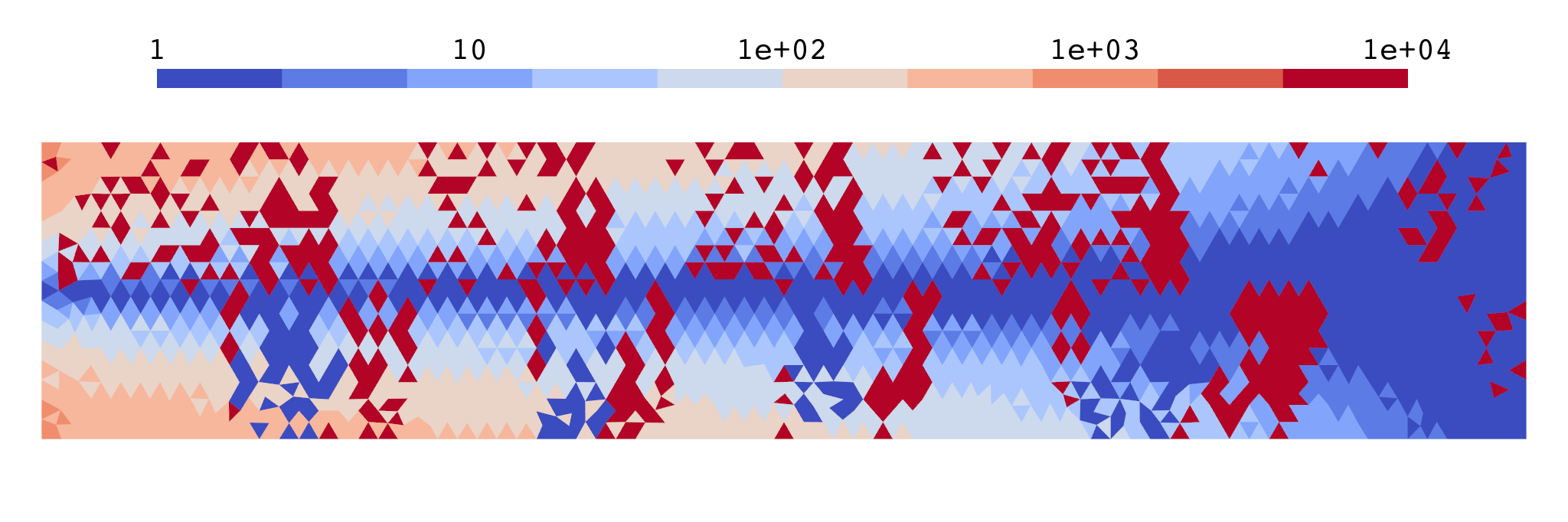
(a)Assembled unstable strain energy density W.
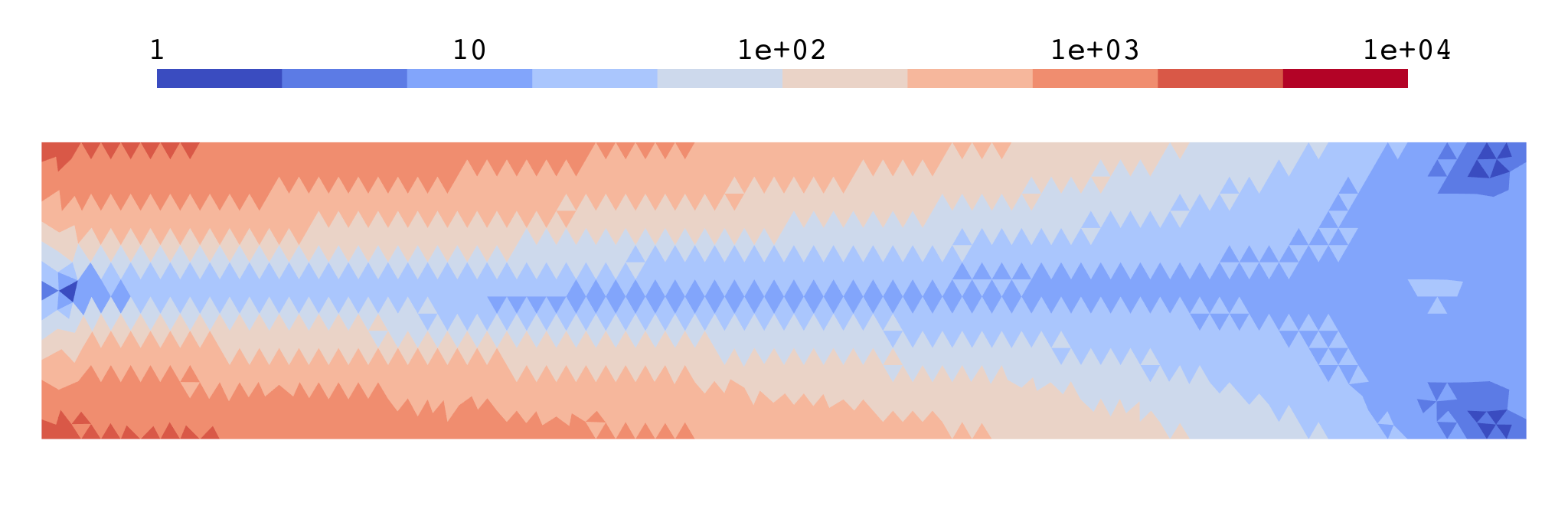
(b)Assembled stable strain energy density W_stable.
Figure 1:Assembled strain energy densities (in Pa): unstable (top) and stable (bottom).
Source
if comm.size == 1:
    # Create pyvista grid
    grid = pv.UnstructuredGrid(*dolfinx.plot.vtk_mesh(mesh))

    # Add data to grid
    grid.cell_data["Rel. error bound (W, worst) [-]"] = np.abs(rel_error_fn.x.array)
    grid.cell_data["Rel. error estimate (W, exact) [-]"] = np.abs(rel_error_fn_exact.x.array)

    save_field_plot(
        grid, "Rel. error bound (W, worst) [-]", "error_unstable_worst.png", clim=(1e-1, 1e7)
    )
    save_field_plot(
        grid, "Rel. error estimate (W, exact) [-]", "error_unstable_exact.png", clim=(1e-1, 1e7)
    )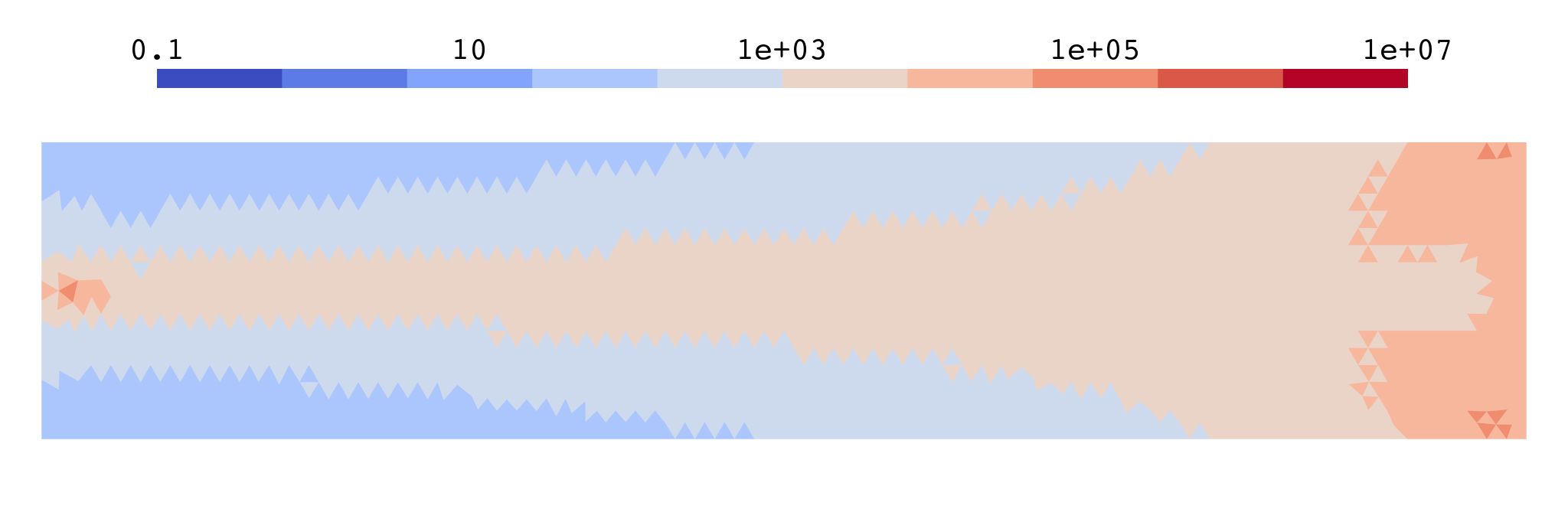
(a)Rel. error bound for W and "worst" mode.
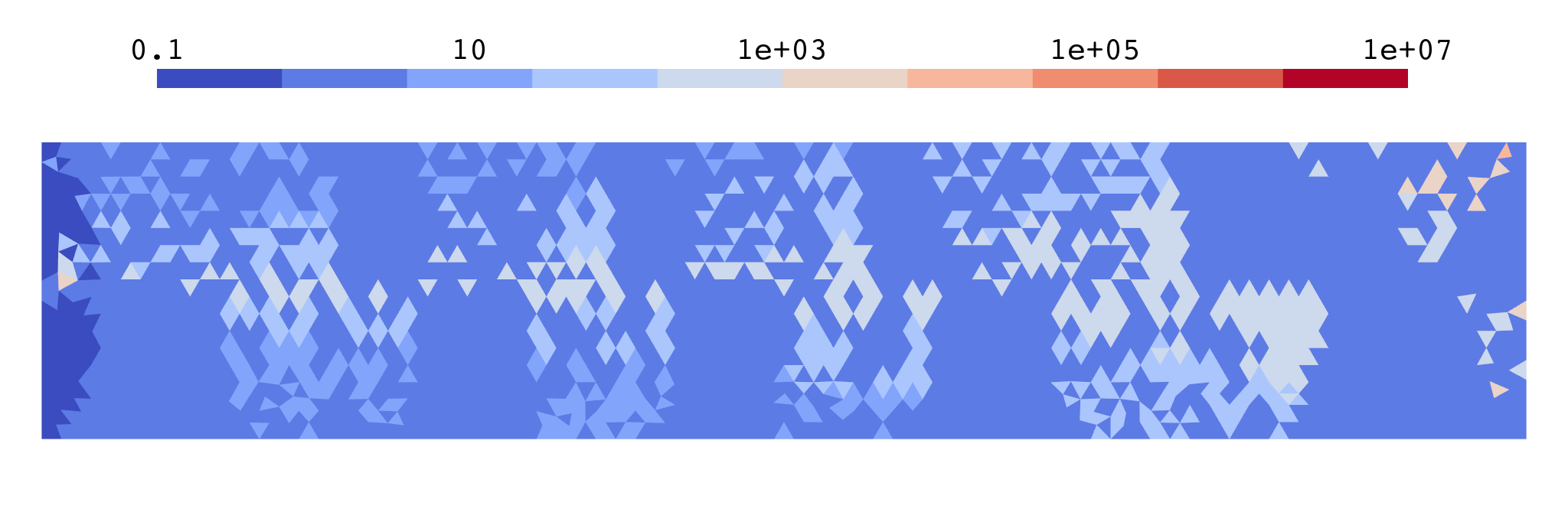
(b)Rel. error estimate for W and "exact" mode.
Figure 2:Relative rounding error for the unstable expression : “worst” mode bound (top) and “exact” mode estimate (bottom) show the pessimism of the worst-case bound.
Source
if comm.size == 1:
    # Create pyvista grid
    grid = pv.UnstructuredGrid(*dolfinx.plot.vtk_mesh(mesh))

    # Add data to grid
    grid.cell_data["Rel. error bound (W_stable, worst) [-]"] = np.abs(rel_error_approx_fn.x.array)
    grid.cell_data["Rel. error estimate (W_stable, exact) [-]"] = np.abs(
        rel_error_approx_fn_exact.x.array
    )

    save_field_plot(
        grid,
        "Rel. error bound (W_stable, worst) [-]",
        "error_expansion_worst.png",
        clim=(1e-8, 1e-2),
    )
    save_field_plot(
        grid,
        "Rel. error estimate (W_stable, exact) [-]",
        "error_expansion_exact.png",
        clim=(1e-8, 1e-2),
    )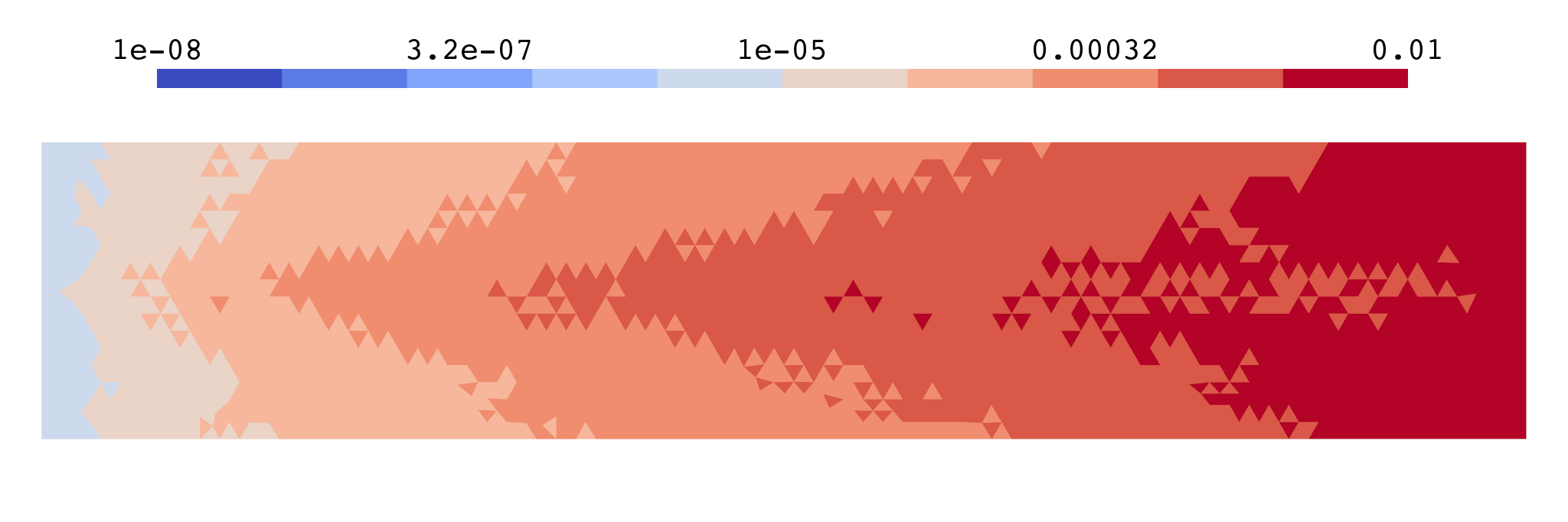
(a)Rel. error bound for W_stable and "worst" mode.
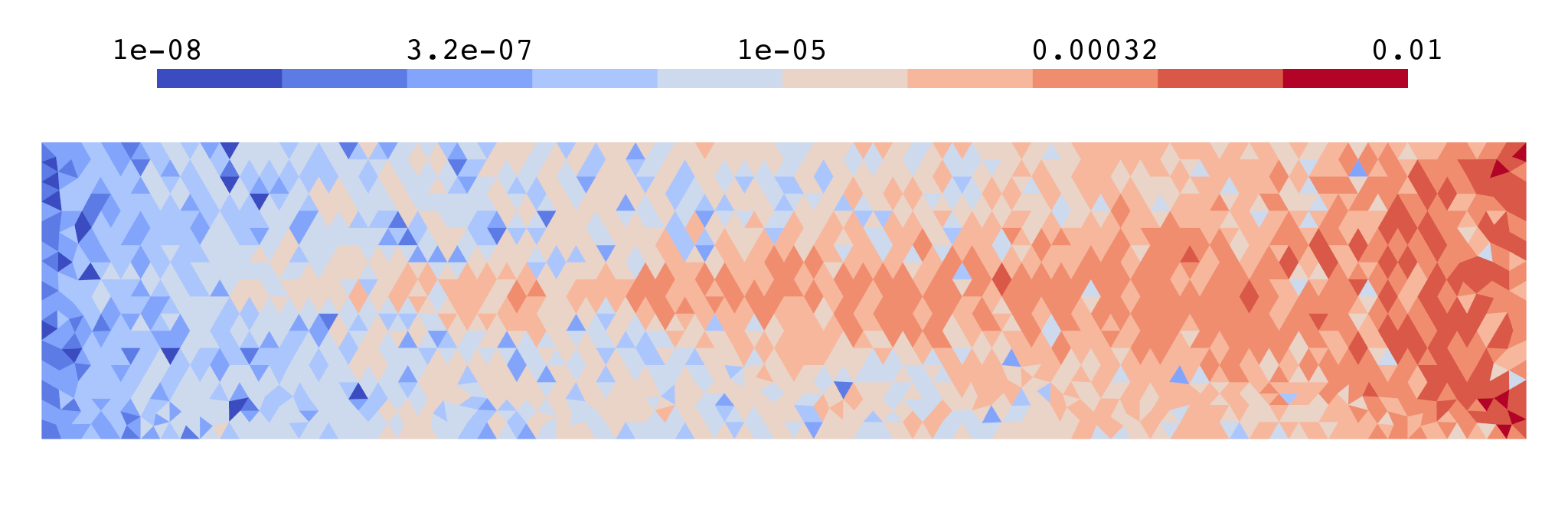
(b)Rel. error estimate for W_stable and "exact" mode.
Figure 3:Relative rounding error for the stable expression : “worst” mode bound (top) and “exact” mode estimate (bottom) demonstrate significantly lower error accumulation due to improved numerical stability.
- Higham, N. J. (2002). Accuracy and Stability of Numerical Algorithms (2nd ed.). Society for Industrial. 10.1137/1.9780898718027
- Pence, T. J., & Gou, K. (2014). On compressible versions of the incompressible neo-Hookean material. Mathematics and Mechanics of Solids, 20(2), 157–182. 10.1177/1081286514544258
- Shakeri, R., Ghaffari, L., Stengel, K., Thompson, J. L., & Brown, J. (2024). Stable numerics for finite-strain elasticity. International Journal for Numerical Methods in Engineering, 125(24). 10.1002/nme.7563
- Habera, M., & Zilian, A. (2026). Automated dimensional analysis for PDEs. arXiv. 10.48550/ARXIV.2601.06535